My father never hit me. I want to say that at the beginning, because I know it's the first thought people have — the first bar they reach for to measure whether abuse is real. He never hit me. He was never violent. He was, by most visible measures, a good father.
He came to my school performances. He paid for my education. He said he loved me, regularly, in front of others. He made people laugh and feel seen. He was, as I've said many times, the kind of man who lights up a room.
But he was also the kind of man who could make you feel, with a single look, like you had ceased to exist. Like the only crime worth punishing in his household was the crime of disappointing him. And the definition of disappointment shifted constantly — which meant that I spent most of my childhood in a state of low-grade vigilance, monitoring for signs of the temperature change that would arrive without warning and linger without explanation.
This is what a narcissistic father does. Not all at once. Not in ways that are easy to point to. But over time, in a thousand small accumulations, he teaches you that your value is conditional. That love is earned and withdrawn. That you are only as worthy as your last performance of goodness.
The Experience
What It Felt Like to Grow Up With Him
There is a particular loneliness to being the child of a covert narcissist. It is not the loneliness of neglect — where absence is at least legible, at least consistent. It is the loneliness of being present in a relationship that constantly withholds. Of being loved, sometimes, but never safely. Of spending your whole childhood reaching for a version of your parent that keeps disappearing.
My father was warm with me sometimes. Those periods were real and I do not minimise them. He read to me. He took me to the library. He laughed, genuinely, at things I said. And those moments — that warmth — were the thing that made the rest so confusing. Because if he was capable of that, then when the coldness came, it had to be my fault. I had done something to lose it. I had to figure out what, and fix it, and earn it back.
That is the trap. That is the specific architecture of covert narcissistic parenting: enough warmth to keep you attached, enough withdrawal to keep you striving. It is — and I say this now with clinical precision, not as a child but as the psychologist I became — a form of intermittent reinforcement. The same mechanism that makes slot machines addictive. The variable reward schedule that neurobiologically produces the strongest possible bond.
By the time I was twelve, I had become a highly skilled people-pleaser. I monitored the emotional atmospheres of every room I entered. I adjusted my behaviour, my volume, my opinions, my desires — always in service of whoever held the most relational power. I had learned that my job was to manage other people's feelings. My own feelings were a complication, a disruption, something to be apologised for.
I was an excellent student, an easy friend, a reliable daughter. I was praised for all of these qualities. No one saw — because how could they? — that underneath each of them was not confidence or generosity but an anxious calculation: if I do this correctly, if I am good enough, the love won't be taken away again.
I was twenty years old, sitting in a lecture hall during her academic studies in psychology. The professor was speaking about personality disorders. When she described the covert narcissist — the contrast between public warmth and private contempt, the conditional love, the emotional withdrawal as punishment, the need for admiration combined with the inability to tolerate others' success — I felt something happen in my chest that I can only describe as a hinge giving way.
I went to the library that night. I read for three hours. I looked up paper after paper, book after book. I didn't go home. I sat in that library as the light outside shifted from grey afternoon to black night, and I read about my father. About my childhood. About myself.
I wept. Not from sadness — although there was sadness in it. I wept from the specific, almost violent relief of recognition. It was real. It had a name. I was not crazy. I was not dramatic. I was not the sensitive, oversensitive, too-much daughter that his sighs and silences had tried to make me.
I was a person who had been subtly but systematically taught to disbelieve her own experience. And I had just found the first document that told me the truth.
Clinical Perspective
What Is "The Father Wound"?
The concept of the "father wound" predates modern clinical psychology — it appears in Jungian theory, in cultural mythology, in religious frameworks across civilisations. At its core, it refers to the psychological injury created by a father who was emotionally unavailable, absent, controlling, or abusive. The father wound is not simply about bad fathering. It is about the specific developmental rupture that occurs when the child's primary male attachment figure fails to provide the emotional safety that attachment theory tells us is necessary for healthy development.
When that primary figure is a narcissist — particularly a covert narcissist — the wound takes on specific characteristics. Because the abuse is covert, there is no visible evidence. The child cannot point to anything that the outside world would recognise as harm. This creates a double bind: the child experiences real psychological damage from real, ongoing emotional manipulation, but has no language for it and no external validation of it.
The Psychological Effects of a Narcissistic Father
Based on two decades of clinical work with adult survivors, Eleanor identifies the following as the most common long-term psychological effects of growing up with a narcissistic father:
- Hypervigilance to others' emotions: The child learns to read emotional atmospheres with extraordinary precision — a survival skill that follows them into every relationship and workplace, often manifesting as anxiety or an inability to relax.
- People-pleasing as an identity: When a child's emotional safety depends on managing a parent's moods, people-pleasing becomes not a strategy but a personality — so deeply embedded that the person often doesn't experience it as a choice.
- Toxic shame and low self-worth: Children of narcissistic fathers frequently internalise the message that they are fundamentally inadequate — that they must earn love, that they are too much or not enough, that something is essentially wrong with them.
- Difficulty with boundaries: A child raised by a narcissist is taught, implicitly and explicitly, that their boundaries do not matter. As adults, these individuals often find boundary-setting almost physically painful — it triggers intense guilt, fear of abandonment, or the sensation of being selfish.
- Attraction to unavailable or controlling partners: The familiar emotional landscape of the narcissistic relationship — the warmth-withdrawal cycle, the conditional love, the need to earn approval — often becomes the template for adult romantic attachment. What felt like home becomes what feels like love.
- Difficulty trusting their own perceptions: Years of gaslighting — however subtle — erode the child's confidence in their own internal experience. As adults, they frequently second-guess themselves, minimise their own needs, and defer to others' interpretations of reality.
- CPTSD and emotional dysregulation: When the relational wounding is severe enough and prolonged enough, it can produce the constellation of symptoms associated with Complex PTSD: emotional flashbacks, toxic shame, the inner critic, and difficulty maintaining stable self-esteem.
From Wound to Mission
How the Father Wound Shaped Eleanor's Books
Everything Eleanor Voss has written is, in some fundamental sense, written to the person she was before she had words. Every book in the Your Chaos Has a Name series is a document of recognition — the clinical language that the child in a narcissistic household desperately needs and never receives.
When she describes the covert narcissist in Volume 1, she is describing her father. When she explains, in Volume 2, why the bond with an abusive person is so hard to break, she is explaining her own twenty-something years of repeating her father's relational pattern in partner after partner. When she writes, in Volume 3, about reclaiming an identity that abuse has eroded — she is writing from the inside of that work, not from a clinical distance above it.
This is not therapeutic self-disclosure in the clinical sense. It is something more considered: the deliberate, structured use of personal experience to reach people who would otherwise remain unreachable. Eleanor knows — because she was that person — that for someone in the grip of narcissistic abuse, the most important thing is not advice. It is recognition. The specific, cellular recognition of: someone else has been here. Someone else knows what this is. It is real. I am not crazy. It has a name.
My father is still alive. He has never apologised. I do not expect that he will. The clinical literature is consistent on this: covert narcissists rarely, if ever, develop the genuine insight required to offer a true apology — not a tactical one designed to restore their image, but a real one that acknowledges harm and accepts responsibility.
For a long time, I waited for it anyway. I think many children of narcissists do. The apology becomes a kind of anchor — something that keeps us tethered to the hope that the loving version of our parent was the real one, and that if we can just get him to admit it, we can have that version back.
The day I stopped waiting was not dramatic. It was quiet. I was sitting in my clinical office after a long day, and I realised that I was forty-three years old, and I had been managing my father's emotional world since I was six, and I was done. Not from anger. Not from grief — or not only. I was done from something clearer and more certain than either of those things. I was done because I finally, fully believed — in the marrow of my bones, not just in my psychology textbooks — that I deserved a love that did not cost me my sanity. And he could not give me that. He never could.
That was the beginning of my real healing. Not the books. Not the degree. Not the clinical work. That quiet, unremarkable Tuesday afternoon when I stopped waiting for a man to become capable of something he was constitutionally unable to give.
I write that for every reader who is still waiting. You can stop. The love you deserved was real. The fact that he couldn't give it does not mean you were wrong to need it. It means you were human, and he could not meet you there.
That, I think, is enough to know.
"The father wound does not heal when the father changes. It heals when you stop needing him to."— Eleanor Voss
In the Books
Explore Eleanor's Complete Recovery Series
The father wound is woven through all four volumes of Your Chaos Has a Name — from the first recognition of narcissistic patterns, through the work of dissolving the bond, to genuine and embodied freedom.
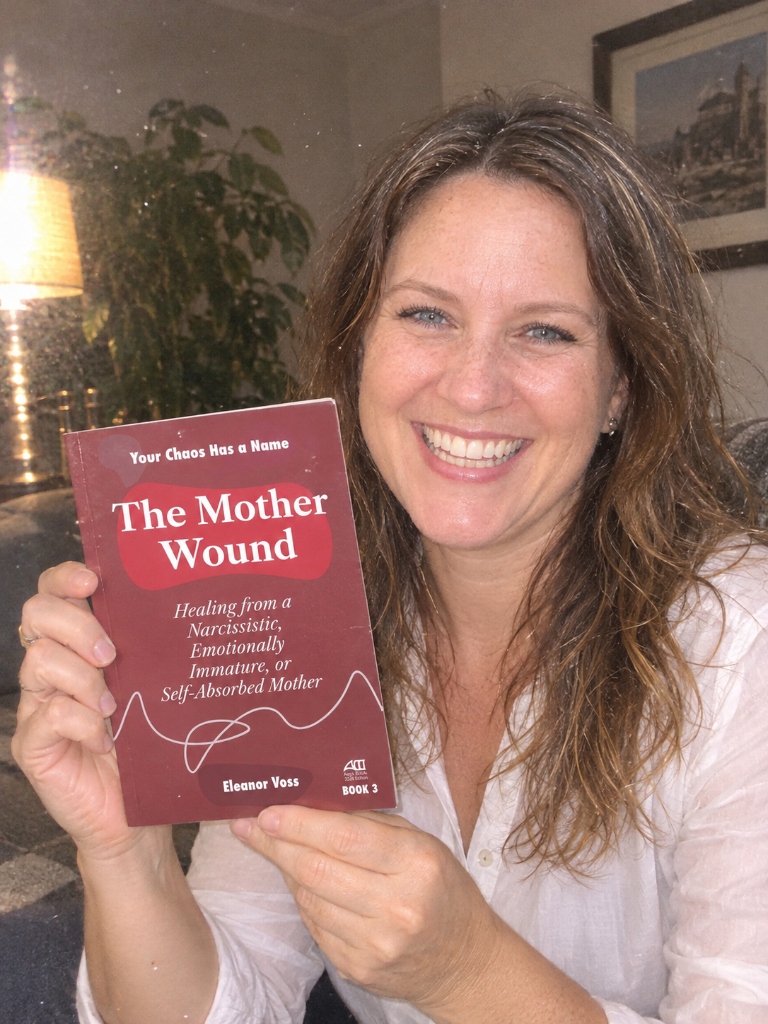
“The Mother Wound” — Book 3 of the Series
Eleanor Voss holding the official paperback edition of The Mother Wound. Rooted in her personal journey unraveling family trauma and over 20 years of clinical psychology expertise since earning her psychology degree with honors at 24, this book provides the definitive roadmap out of toxic emotional enmeshment.
“When you grow up with narcissistic conditioning, surviving feels normal. Healing is learning how to finally live.”
— Eleanor Voss, 48 · Los Angeles