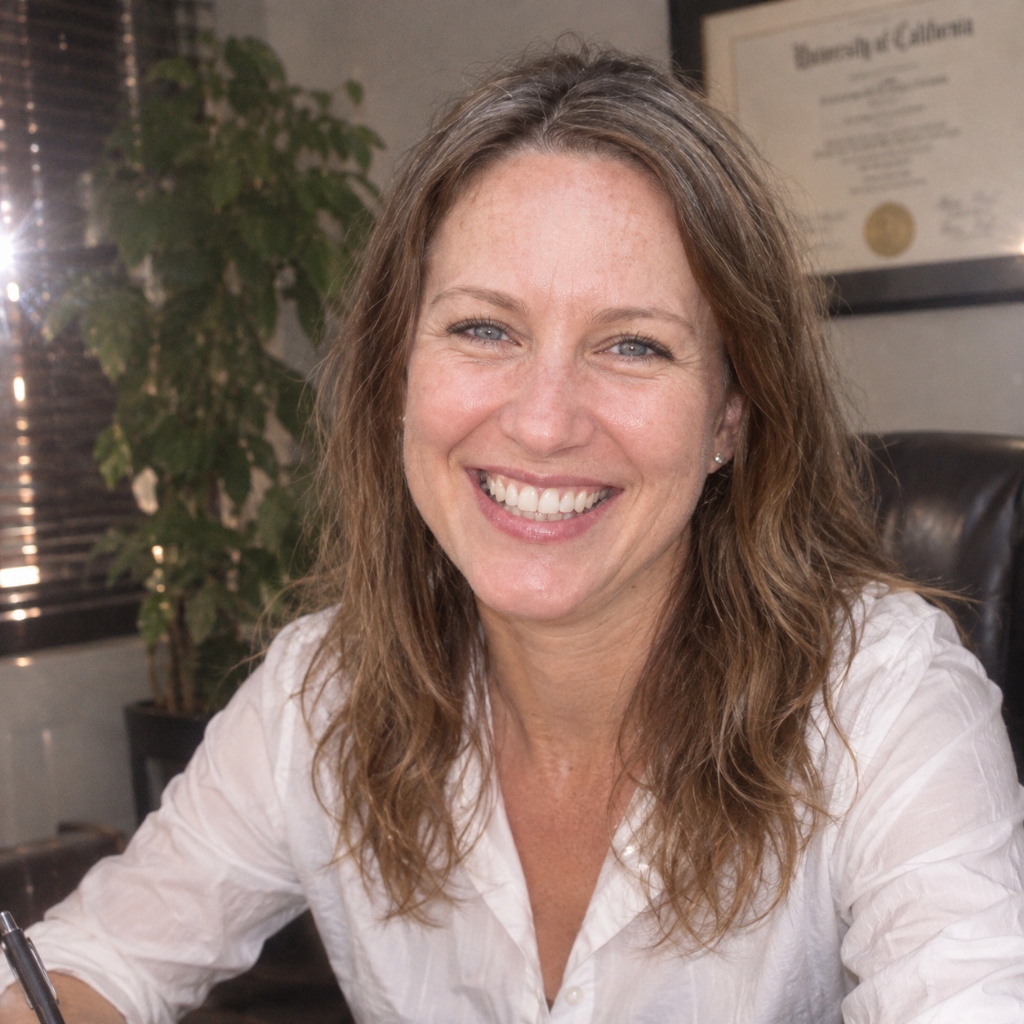
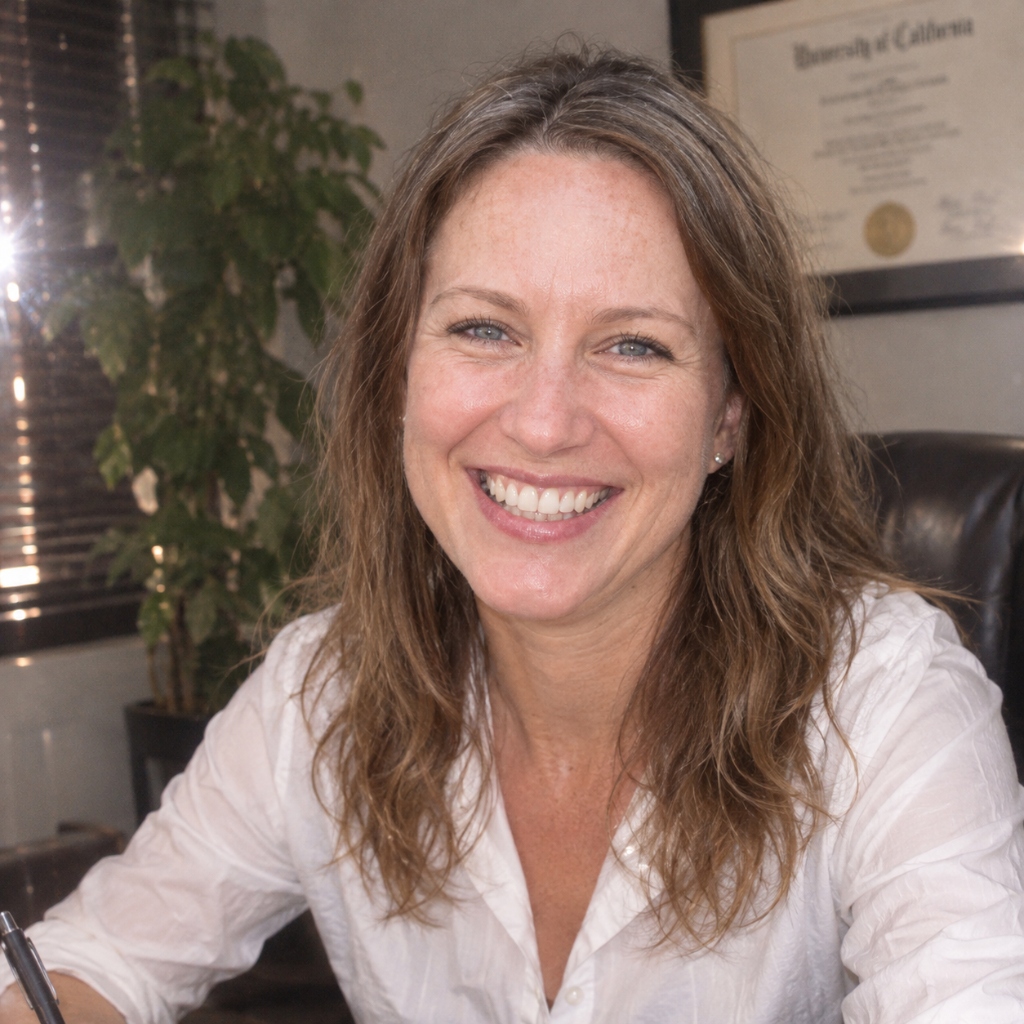
Who She Is
Eleanor Voss — The Complete Story
Some people become psychologists because they are fascinated by the human mind. Eleanor Voss became one because the human mind — specifically, one very particular and very controlling human mind — shaped her entire childhood, and she needed to understand why.
Born in 1978, Eleanor grew up in a household that looked, from the outside, like any other. Her father was well-regarded in his community — charismatic, witty, the kind of man who remembered people's names and made them feel special. But behind the front door of their home, a different version of him existed: cold when he wanted to punish, controlling in ways that left no visible marks, capable of a silence so complete and so contemptuous that Eleanor describes it as "being erased."
She didn't have the words for it then. She was a child. She only knew that loving her father was complicated — that it always cost her something, and that the cost was invisible to everyone around her who thought he was wonderful.
That is the story of Eleanor Voss. It is a story of a wound, a word, a degree, a career, and finally — at 44 — a pen. It is the story of one woman's refusal to let her pain be only personal. It is the story of twenty books she plans to write so that the wound ends with her generation.
Life Timeline
From Childhood to Bestselling Author
Eleanor Voss was born in 1978, the eldest of two children. From her earliest memories, she was acutely aware of her father's emotional volatility — not the explosive kind that leaves obvious evidence, but the covert kind: the cold withdrawals, the loaded silences, the way warmth could vanish without warning and without explanation.
Her father was, by most external measures, a successful and charming man. He was funny and sociable. He gave to charity. People at church adored him. But at home, he operated by different rules — rules that Eleanor learned early and memorised carefully. The rules were: do not disagree, do not ask for too much, do not have feelings that inconvenience him, do not exist too loudly.
She describes her childhood as "a constant exercise in reading moods." She became expert at detecting the first signs of his withdrawal — a particular set of his jaw, a quietness over dinner that was different from other quietnesses. She learned to manage her own emotions long before she had the language to describe them. She shrank. She pleased. She became, by the time she was a teenager, one of those children who adults describe as "so mature, so easy" — not knowing that this maturity had been forged in anxiety, not wisdom.
By her early teens, Eleanor had also begun to understand that she was drawn to people who mirrored her father's patterns. Friends who were inconsistent. Dynamics where she always did more. Relationships where her feelings were secondary. This was not conscious. This was simply what felt like home.
"I loved him desperately. And loving him always cost me something — my opinion, my joy, my sense of reality."— Eleanor Voss, on her father
Eleanor enrolled at the California psychology programs in 1998, choosing to study psychology in that particular way people choose things that feel urgent rather than simply interesting. She was bright, diligent, and driven by a hunger to understand something she could not yet fully name.
It was in the second year of her degree, sitting in a developmental psychology lecture at age 20, that she heard a phrase that stopped her entirely: narcissistic personality disorder. The professor described the behavioural hallmarks — the oscillation between grandiosity and vulnerability, the profound lack of empathy beneath the social mask, the need for admiration, the specific cruelty deployed toward those in intimate proximity — and Eleanor felt, as she later wrote, as though someone had switched on a light in a room she had been navigating in the dark for twenty years.
She went to the library that night and stayed for three hours. She read everything she could find. She wept — not from sadness, she clarifies, but from a form of recognition so complete it was almost physical. It had a name. The chaos of my childhood had a name.
From that point forward, Eleanor's academic path was clear. She focused her studies on personality disorders, attachment theory, and the developmental psychology of children raised in emotionally abusive or neglectful environments. She wrote her thesis on the long-term attachment patterns in adult children of emotionally unavailable parents — a subject that was, as her supervisor once noted with gentle perception, "clearly something she understood from the inside."
She graduated in 2002 with honours, at age 24.
After graduating from her university program, Eleanor entered the clinical world. For the next twenty years, she worked in a variety of clinical and counselling settings, building a practice focused specifically on survivors of emotional and narcissistic abuse. She worked with adults at all stages of recovery — those who were still in the fog of an ongoing abusive relationship, those navigating separation, and those in the longer, slower work of genuine recovery.
During this period, she honed a clinical vocabulary and an approach that was both evidence-based and deeply humane. She drew on trauma bonding research, attachment theory, somatic healing approaches, and cognitive frameworks — but she also brought something to her clinical work that no textbook can provide: the lived knowledge of someone who had been there. Her clients, she says, often sensed it. "They would look at me and say, 'You understand, don't you?' And I did."
Through her clinical work, she developed what she describes as a "pattern map" of narcissistic abuse — the specific sequence of behaviours, the particular language of covert manipulation, the precise ways in which prolonged abuse reshapes a healthy person's self-perception. This map became the foundation of everything she would eventually write.
But there was always a tension. For every client she helped one-to-one in a therapy room, she was acutely aware of the many thousands — perhaps millions — she couldn't reach. People in rural areas with no access to specialist therapists. People who couldn't afford therapy. People who didn't yet even know that what they were experiencing had a name. This awareness grew heavier with every year. By the time she was in her early forties, it had become something she could no longer set aside.
At 44, Eleanor Voss sat down and wrote the first chapter of The Covert Narcissist. She describes it as "letting the dam break." Twenty years of clinical observation, personal experience, and intellectual processing poured out of her with an urgency and clarity that she says surprised even herself. She wrote quickly — not carelessly, but with the confidence of someone who has been thinking about these words for two decades and finally has permission to say them.
The book launched on Kindle. Within 72 hours, it had sold out. Reader messages began to arrive — from women who had been trying to explain their marriages to their families for years and had just found the words, from adult children of narcissistic parents who were reading about their own childhoods in the pages of a book, from men who had never encountered language for what had happened to them in a relationship with a narcissistic partner. The messages did not slow down.
She kept writing. The second, third, and fourth volumes followed — each one mapping a different stage of the journey from recognition to freedom. The series, Your Chaos Has a Name, is now a complete four-volume body of work available on Amazon in Kindle and paperback formats.
Today, at 48, Eleanor Voss is based in Los Angeles, California, where she continues to write, work clinically, and build an online community on TikTok and Pinterest where she shares clinical insights, survivor resources, and the kind of validation that many of her followers say they have never received anywhere else.
As for her father — he never apologised. He never acknowledged the harm. Eleanor stopped waiting for him to. That, she says quietly, was the beginning of her real healing. "The moment I accepted that the apology was never coming," she has written, "was the moment I stopped needing it."
"The moment I accepted that the apology was never coming was the moment I stopped needing it. That is what I wish for every person who reads my books — not closure from someone else, but freedom from the waiting."— Eleanor Voss
Reader Voices
What Readers Say About Eleanor's Books
From Amazon reviews, emails, and social media — the words of readers whose lives have been changed by Your Chaos Has a Name.
"I read the first three chapters and had to put the book down because I was crying so hard. Not from sadness — from recognition. Eleanor Voss has described my entire childhood in clinical terms that make me feel, for the first time, like I am not crazy. I am not dramatic. I am a person who was gaslit by someone who should have protected me."
"I've been in therapy for two years and still couldn't articulate to my therapist what was happening in my marriage. I read Volume 2 — The Trauma Bond — in one sitting and sent my therapist a 10-page summary. She texted back: 'this is exactly it.' Eleanor Voss did in 200 pages what I couldn't do in two years of weekly sessions."
"As a man who survived a relationship with a covert narcissist — which is something nobody talks about, because everyone assumes the victim is a woman — this book finally gave me language for what happened to me. I didn't feel manipulated by a 'crazy woman.' I was systematically broken down by someone with a personality disorder. Knowing that changed everything."
"I am 61 years old and I have spent my entire adult life wondering what was wrong with me. I have been in and out of therapy since my thirties. It was Eleanor Voss's biography and her book on the covert narcissist that finally made me understand: nothing was ever wrong with me. Everything was wrong with the people I was taught to love. I am crying as I type this."
Begin Your Recovery
Read Eleanor's Books
All four volumes of Your Chaos Has a Name are available now on Amazon in Kindle and paperback. Start wherever you are. The books will meet you there.
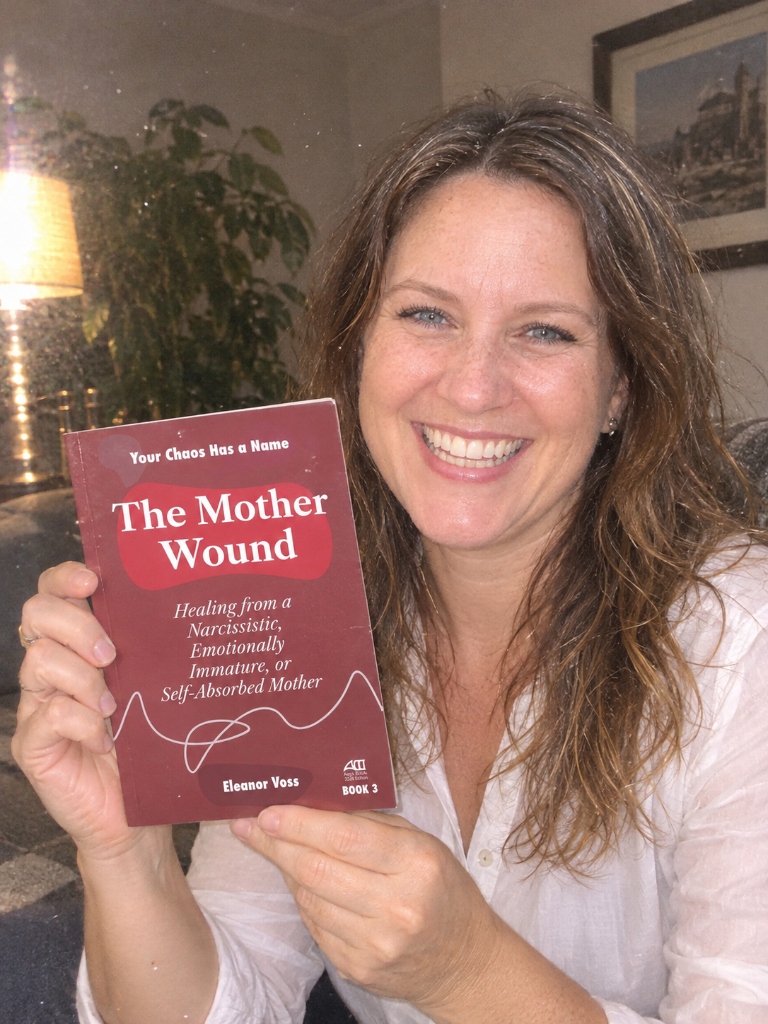
“The Mother Wound” — Book 3 of the Series
Eleanor Voss holding the official paperback edition of The Mother Wound. Rooted in her personal journey unraveling family trauma and over 20 years of clinical psychology expertise since earning her psychology degree with honors at 24, this book provides the definitive roadmap out of toxic emotional enmeshment.
“When you grow up with narcissistic conditioning, surviving feels normal. Healing is learning how to finally live.”
— Eleanor Voss, 48 · Los Angeles